
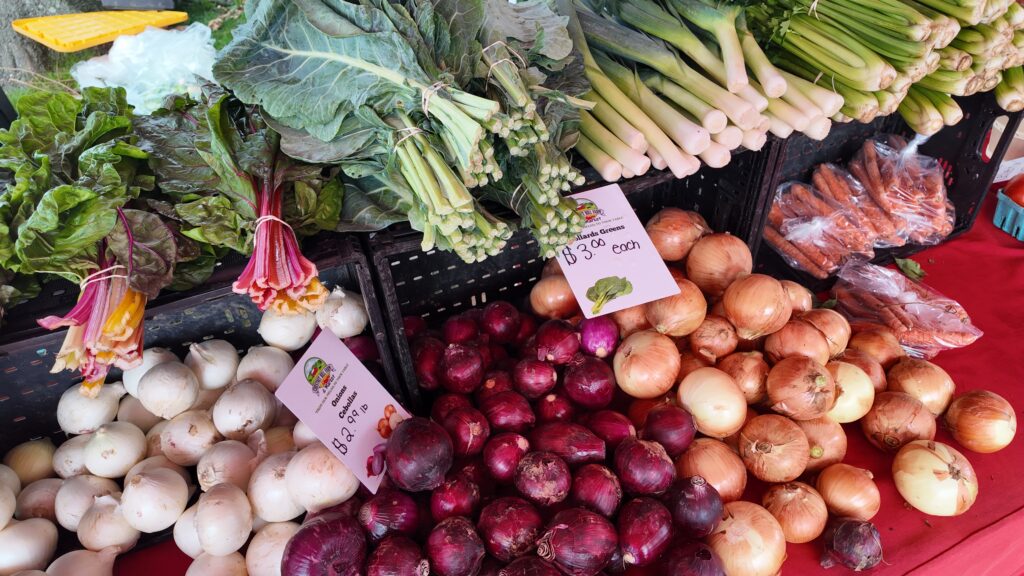
Yasmin has been going to Crossroads Farmers Market for more than a decade. She comes for the fresh produce, but says it’s more than that.
“It reminds me a lot of the market where I’m from,”said Yasmin, who grew up overseas. “I love coming here to share with my friends and neighbors.”
This year, Crossroads turns 20. It’s grown every season since 2020, and on a typical Wednesday, attendance can top 1,200 shoppers, according to Farmers Market Program Manager Omar Marroquin. In the middle of summer, he said, it regularly passes a thousand.
“I love it here,” Marroquin said. “Farmers are the coolest people in the world.”
How the market started
Crossroads Farmers Market opened 20 years ago in Takoma Park. Gus Schumacher helped create it. Schumacher served as the U.S. Department of Agriculture’s Under Secretary for Farm and Foreign Agricultural Services under President Bill Clinton. He died in 2017.
A federal nutrition incentive program now carries his name. The Gus Schumacher Nutrition Incentive Program funds “double dollar” style programs at farmers markets across the country, similar to Crossroads’ own Fresh Checks program.
“It’s amazing. It tells you the impact he had,” Marroquin said. “To see his name on that at the USDA level, and to have him tied to Crossroads, is something to be proud of.”
Marroquin said Schumacher’s original vision was deliberate. Neighbors near Takoma weren’t accessing the area’s Sunday farmers market because prices were higher and it was harder to reach, Marroquin said, citing historic information kept in the market’s office. Crossroads became the first farmers market in Maryland to accept Supplemental Nutrition Assistance Program (SNAP) and Women, Infants and Children (WIC) benefits. It was also the first market in the country to double their value, matching what shoppers spent dollar for dollar.
“That was a major move,” Marroquin said. “It’s been replicated thousands of times across the country since then, but it started here.”
What Fresh Checks does
Fresh Checks matches what shoppers spend using SNAP or WIC benefits at the market. SNAP shoppers swipe their Independence Card at the Crossroads tent, and the market matches what they spend, up to $50 a week. WIC and senior shoppers redeem their vouchers directly with farmers, then get a matched amount, also up to $50 a week, in Fresh Checks to buy more food.
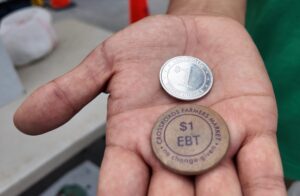
“We’re trying to boost those programs to incentivize people to come and help them shop and buy more once they’re here,” said Executive Director Lauren Goldberg.
The market distributed $161,471 in Fresh Checks last year, reaching more than 2,200 households, a 67% increase since 2020. Over the market’s last 18 seasons, it has distributed more than $1 million in Fresh Checks to 26,000 residents.
Market sales reached $402,909 in 2025, up 7% from 2024 and up 54% since 2020. Nearly 60% of the market’s sales come through SNAP, WIC and Fresh Checks combined.
“This was the first farmers market in the country to provide matching when people shop with their benefits,” Goldberg said. “It’s exciting that this has become a model replicated all over the country.”
SNAP cuts bring new pressure
The market’s growth hasn’t come without headwinds. A federal spending bill passed in July 2025 cut SNAP funding, tightened eligibility rules and ended funding for SNAP nutrition education entirely as of Sept. 30, 2025. About 68,000 Montgomery County residents rely on SNAP every month.
Marroquin has watched the cuts play out at the market level. “It was frustrating to hear about the SNAP cuts and it being harder for people to apply for those benefits,” he said. Families who would qualify sometimes hesitate to apply now, he said, because of new documentation requirements and fears the process could tie back to their immigration status.
Even so, Marroquin said the market has held steady. “It’s about the same as last year,” he said of SNAP use at the market.
Maryland has also stepped in to help. Gov. Wes Moore’s administration launched an online tool this month connecting SNAP recipients to the state’s largest ever network of job training providers, and the state has texted 14,000 Marylanders who lost benefits due to new paperwork requirements, letting them know they can reapply.
Crossroads described the year as one that called for extra care. In its own year-end review, the organization said it prioritized “trust, continuity and presence” for the community it serves.
The vendors who make it work
The market has 22 vendors. Most are small, local businesses. What’s more, 68% are BIPOC owned, 64% are women owned and half are immigrant-owned enterprises.
David Varillas runs R.L. Vegetables with his wife. This is their fifth year at the market. His mother-in-law started the business at Crossroads in 2017 and handed it to the couple when she retired.
“It’s very important to me to grow some good stuff,” Varillas said, pointing to regulars who ask him for hierba mora, a nutrient-rich herbal plant you can eat, and other specialty items. “We like to see people happy because they found what they’re looking for.”
Business has picked back up after a slow stretch, he said. “Little by little, we’re getting better.”
His customers keep him coming back, too. “They are very important to us,” he said. “We want them to be happy.”
Why people keep coming back
Mr. David, a Montgomery County resident who has shopped at the market for three years, said the location keeps him coming back. “The farmers market is near my house,” he said. “Shopping and the bank are nearby.”
Goldberg said that feeling is by design. “There’s just a really wonderful feeling and vibe here,” she said. “We have music almost every week.”
Looking ahead
Marroquin said the market’s 20th year has brought out longtime residents who are just now discovering Crossroads for the first time. He expects growth to continue, especially once the Purple Line opens a stop in front of the market.
“That encourages me that we’re going to have another 20 years after this,” he said.
The post After 20 years, Crossroads Farmers Market still feels like home appeared first on Montgomery Community Media.

