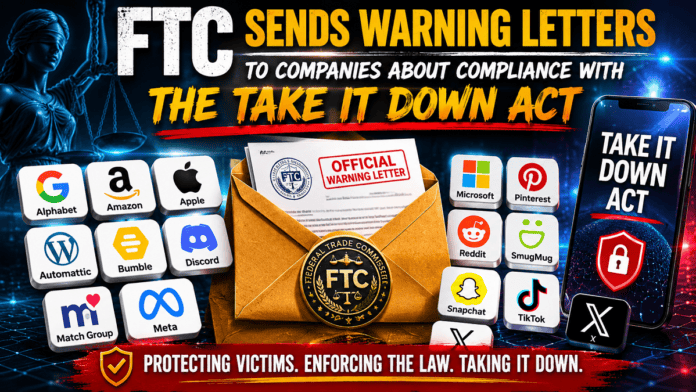

The Federal Trade Commission has sent warning letters to 12 websites offering “nudify” tools that use artificial intelligence to remove clothing from images and create nonconsensual sexualized content. The letters remind the companies of their obligations under the TAKE IT DOWN Act, which requires online platforms to provide a process for victims to request removal of intimate photos or videos shared without consent and to act within 48 hours of a valid request.
The FTC began enforcing the law on May 19, 2026. The warning letters note that the companies appear to be in violation by failing to offer victims a clear removal process. Companies that do not come into compliance could face legal action and civil penalties of up to $53,088 per violation.
FTC Chairman Andrew N. Ferguson emphasized the seriousness of enforcement. “Today we’re demonstrating just how serious we are about protecting the public, especially children, from abusive online conduct,” Ferguson said. “Platforms no longer have any excuses — they must comply with their obligations under the TAKE IT DOWN Act or face the consequences.”

The TAKE IT DOWN Act was championed by First Lady Melania Trump and signed into law by President Donald Trump in May 2025. It gives victims a federal mechanism to force removal of nonconsensual intimate images, including AI-generated deepfakes. The law applies to all covered platforms and requires them to remove known identical copies as well.
In Maryland, the new federal law strengthens existing state protections. Maryland Criminal Law §3-809 already prohibits the nonconsensual distribution of intimate images, with penalties of up to two years in prison and a $5,000 fine. In 2025, the state expanded its revenge porn statute to explicitly cover AI-generated deepfakes. Maryland also has a specific sextortion law that addresses threats to share intimate images to coerce victims.
For families in Southern Maryland, the FTC’s action is particularly relevant. Charles, Calvert and St. Mary’s counties have seen rising reports of online exploitation, especially among teens and young adults. Local law enforcement and school systems have increased digital safety education, but victims often struggle with slow or inconsistent responses from social media companies. The TAKE IT DOWN Act’s 48-hour removal requirement and FTC complaint portal at TakeItDown.ftc.gov give Maryland victims a stronger, faster tool to hold platforms accountable.
The warning letters were sent to companies operating so-called “nudify” tools. These AI services allow users to upload clothed images and generate explicit versions without the subject’s consent. The FTC says these platforms must immediately provide a clear removal process or risk enforcement action.
The agency has also issued guidance for consumers on how to request removal of nonconsensual intimate images and for businesses on how to comply with the law. Last week, Chairman Ferguson sent reminder letters to major platforms including Meta, TikTok, Snapchat, X, Discord and others.
Maryland Attorney General Anthony Brown and other state officials have long advocated for stronger federal action on nonconsensual intimate imagery. The TAKE IT DOWN Act complements Maryland’s efforts and provides victims with both civil and criminal remedies at the federal level.
Victims in Southern Maryland who need help can contact local law enforcement, the Maryland State Police, or victim advocacy organizations. The FTC’s new website offers a straightforward process for filing complaints when platforms fail to act.
The law does not preempt stronger state protections, meaning Maryland victims can still pursue remedies under state law in addition to the federal process. Enforcement of the platform removal requirements is now active. Criminal provisions of the law are already in effect.


