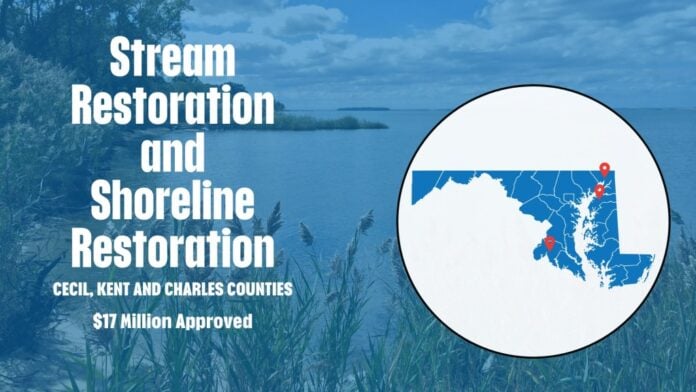


IINDIAN HEAD, Md. — A stretch of Potomac River shoreline in the Town of Indian Head is set for a significant ecological overhaul, with the state of Maryland committing up to $3,685,408 to stabilize the bank, cut nutrient pollution and protect a community long identified as vulnerable to environmental harm.
The Maryland Board of Public Works approved the funding Wednesday, May 20, as part of nearly $17 million announced by the Maryland Department of the Environment through the state’s Clean Water Commerce Act of 2021 — a pay-for-success model that ties state payments to documented, measurable environmental results rather than upfront construction costs.
The Indian Head Shoreline Restoration project — designated BR-CWCA 01.09 and awarded to Ecotone, L.L.C. — is one of three projects approved statewide during this funding round.
What The Project Does
The restoration will target approximately 500 linear feet of shoreline in Indian Head through a hybrid living shoreline and bank stabilization approach. Construction will include headland breakwater structures and rock sills designed to dissipate wave forces on the bank — a method that combines hard infrastructure with natural shoreline features to reduce erosion and filter runoff before it reaches the river.
The project is designed to deliver quantified reductions in nitrogen, phosphorus and total suspended solids entering the Potomac River and, ultimately, the Chesapeake Bay. Under the agreement, the Maryland Department of the Environment will make annual payments to Ecotone, L.L.C. for verified nitrogen reductions based on agreed-upon unit prices — with the company responsible for maintaining the project over a 20-year period.
State officials designated Indian Head as an environmental justice community, making the project eligible for investment focused on both ecological outcomes and community resilience. Funding flows through the Bay Restoration Fund under the Maryland Water Quality Financing Administration Act, §§ 9-1601 through 9-1622 of the Environment Article, Annotated Code of Maryland.
A Statewide Investment, Local Impact
Charles County’s award was joined by two Eastern Shore projects approved during the same Board of Public Works session:
- Stumpf Farm Stream Restoration, Cecil County — up to $8.4 million; projected to reduce nitrogen by 27,000 pounds annually
- Sears Farm Stream Restoration, Kent County — up to $4.9 million; will stabilize approximately 4,000 feet of stream and reduce nitrogen by 9,400 pounds annually
Together, the three projects represent nearly $17 million in state investment tied directly to quantifiable pollution reduction.
Economy, Tourism And The Bay
Maryland Environment Secretary Serena McIlwain called the investments both an environmental and economic priority. “These investments keep our communities safe and our economy strong,” McIlwain said in the announcement. “This is about real results. We are cleaning the water and creating good local jobs. We only pay for projects that work. This is about a cleaner Chesapeake Bay, climate resilience and higher property values.”
Cleaner waterways support Maryland’s tourism industry, which generates approximately $3.2 billion annually in economic activity, while improved habitat and water quality also benefit the state’s seafood industry, which contributes nearly $600 million each year.
Got a tip or photo? Text us at 888-871-NEWS (6397) or email news@thebaynet.com.
Join The BayNet Membership for exclusive perks and zero ads.
Don’t miss a story—sign up for our newsletter!
The post $3.7M Approved To Restore Indian Head Shoreline And Reduce Pollution Entering Chesapeake Bay appeared first on The BayNet.


